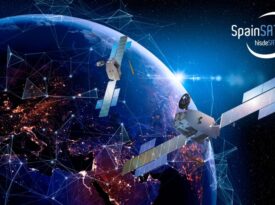

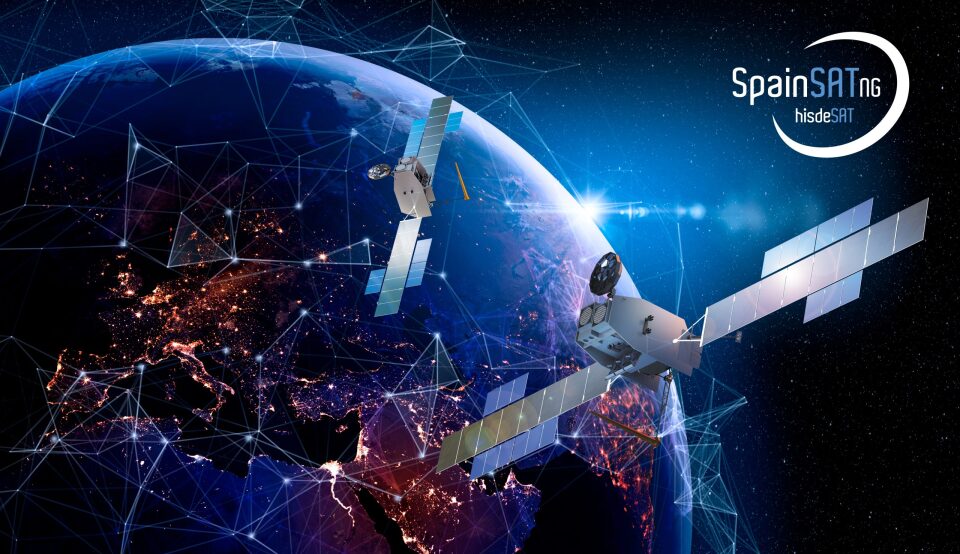
Last week, I had the opportunity to attend Sener's Extended General Management Meeting, where the company's top executives gathered. During the spectacular presentation of the achievements of Aerospace and Defence, a colleague sitting next to me asked me about the data centres in space that Elon Musk's company SpaceX wants to promote. I could only give a brief answer at the time, but I was left with the urge to investigate further.
We are all aware of the boom we are seeing in our sector due to the rise of AI, and it seems that there is no energy on Earth that can satisfy the voracious appetite of this technology. Given the limits of energy and physical space on Earth, a group of tech titans, led by Elon Musk and Jeff Bezos, are proposing a radical alternative: taking servers into space powered by direct solar energy. This idea, which until recently sounded like science fiction, is gaining traction as a possible route to more sustainable and ubiquitous computing.
Current situation
In recent years, large technology companies and aerospace start-ups have launched programmes aimed at developing space-based data centres (SBDCs). These initiatives are based on two key pillars: the availability of continuous solar energy in orbit and the deployment of low-latency Low Earth Orbit (LEO) connectivity constellations as communications infrastructure.
Companies such as SpaceX, Amazon and OneWeb are consolidating global satellite networks capable of offering latencies in the order of 20-40 milliseconds, enabling hybrid Earth-space architectures. In parallel, cloud providers such as Google and Microsoft are exploring models where part of the processing is brought closer to the source of the data, either through experimental orbital clusters or terrestrial data centres connected by satellite links.
Alongside the major players, specialised start-ups such as Axiom Space, Starcloud, Aetherflux and Lonestar Data Holdings have emerged, which have already demonstrated capabilities for processing, storing and training AI models in orbit or even on the lunar surface. These tests confirm that the concept is technically feasible, at least on a small scale.
At the institutional level, the European Union has formally assessed the viability of space data centres, concluding that they could be technically and environmentally competitive in the long term, with a deployment horizon beyond 2035.
Technical feasibility
From an engineering perspective, SBDCs present radically different challenges to conventional data centres:
- Energy: Solar power generation in orbit offers much higher capacity factors than terrestrial power generation, especially in sun-synchronous orbits. However, the available power is limited by the launchable mass, conditioning the computing density. For example, each Aetherflux satellite will carry ~10 interconnected GPUs, along with a 93 m² solar panel (eight parking spaces).
- Thermal management: In the absence of convection, heat dissipation depends exclusively on thermal radiation, requiring large, lightweight, deployable radiators. In the case of Aetherflux mentioned above, a 46 m² radiator is needed to dissipate heat. This is currently the main bottleneck for scaling computing power.
- Radiation and reliability: Electronics must be fault-tolerant and radiation-tolerant, incorporating redundancy and error correction, which penalises performance and cost.
- Communications: Inter-satellite optical networks and Earth-space laser links enable distributed architectures with competitive latencies and high security, although they require specialised ground stations.
- Software architecture: Orchestrating resources on mobile orbital platforms requires new approaches to distributed computing, fault tolerance and advanced load management.
Overall, the technology has moved beyond the conceptual phase, but scalability remains limited by power, thermal dissipation and orbital logistics.
Economic and market viability
The main economic constraint is the launch cost, which is still in the order of thousands of dollars per kilogram in LEO. The business model reverses traditional logic: high initial CAPEX versus almost zero energy OPEX during the system's lifetime. Large-scale viability depends critically on the arrival of fully reusable launchers with costs below ~300 USD/kg, when today we are at approximately 2,500 USD/kg.
Despite this, the potential market is significant. Analysts estimate that off-planet processing and storage services could reach tens of billions of dollars in the next decade, driven by use cases such as:
- in-orbit processing of Earth observation data,
- intensive training of AI models,
- ultra-secure storage for governments and critical sectors,
- provision of cloud services in regions without terrestrial infrastructure.
In the initial phase, these centres will not compete directly with traditional data centres, but will cover niches where their value proposition is unique.
Conclusions
Space data centres are not science fiction, but neither are they an immediate solution to the exponential growth in digital demand. Technically viable and strategically attractive, their mass deployment will depend on key advances in launchers, thermal management and space electronics.
In the short term, SBDCs will act as complementary infrastructure for high value-added applications. In the medium and long term, they could become a new pillar of the digital and space economy, redefining the very concept of cloud infrastructure.
But the most important thing about this study is that if anyone can carry it out from a technical point of view, it is Sener, with its Aerospace, Energy and Quark divisions working in coordination. Frankly, these are big words, and this work would honour our purpose: to transform the world by challenging the limits of technology.
Ricardo Abad
CEO at Quark Sener Group